The Clan's Thoughts
The Amazing Maurice and His Educated RodentsThe Clan's Thoughts are a developing body of shared principles that gives the changed rats a way to understand what they are and how they must live together. They begin as lessons about identity and cooperation, but carry practical weight: knowledge can outlast its possessor, fear can undo a group, and survival depends on treating other thinking beings as more than instruments or prey. Their importance lies not in a finished code but in the Clan's continuing effort to turn thought into conduct.
Origins and Recording
The first Thought is In the Clan is Strength. Peaches records it on paper, working out a system of signs because most rats cannot read human writing. Her drawings include the image of a large rat composed of smaller rats: a visual attempt to make collective strength legible to the community. The work is more than transcription. A principle has to be translated into a form the rats can share and remember.
Writing itself is contested. Dangerous Beans argues that recording knowledge would allow it to survive a rat's death and let others learn what Hamnpork has spent years discovering. Hamnpork resists the prospect that younger rats might gain his accumulated expertise without repeating his long apprenticeship. The disagreement exposes one of the Thoughts' central implications: knowledge kept as an individual's possession dies with that individual, while knowledge made common can strengthen the whole Clan. Peaches' written record gives that argument a material form.
The Thoughts also arise from immediate, ordinary experience. We co-operate, or we die becomes another principle; Peaches works to convey cooperation through the familiar example of rats leading a blind or wounded companion. Not to Widdle where you Eat is much simpler to render, but its place beside the larger claims matters: the shared code encompasses basic habits as well as survival ethics. Peaches adds No Rat to Kill Another Rat, drawing a death sign to make the prohibition unmistakable. Her question about what happens when killing seems necessary leaves the rule's hardest test unresolved rather than pretending that a written maxim removes every dilemma.
Identity, Fear, and Collective Conduct
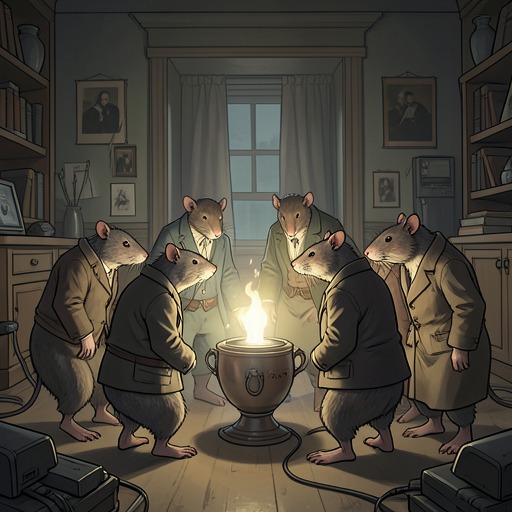
The Clan's identity is stated directly in the Thought that its members are Changelings and not like other rats. The claim is tested by their relationship to fire. Hamnpork regards a candle with suspicion, objects that darkness was good enough for earlier generations, and considers burning food wasteful. Dangerous Beans instead sees controlled fire as a declaration to the darkness: the rats are separate, not merely rats, and belong to the Clan. The flame therefore joins practical knowledge to collective identity. Peaches also reports that younger rats are frightened by shadows, showing that a shared name and a bold principle do not instantly remove fear.
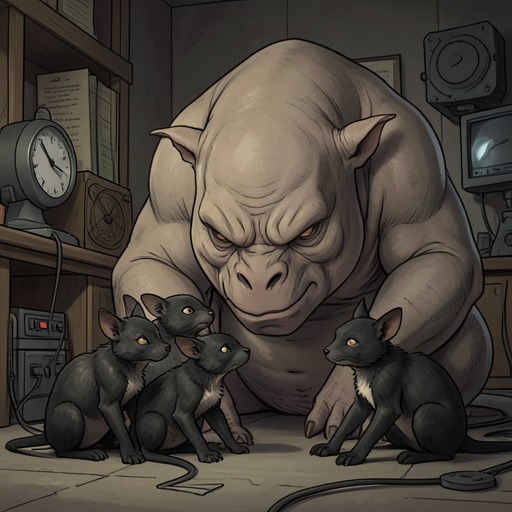
Later events make the difference between an individual rat and a frightened crowd stark. When rats run past in terror, one squeals at Peaches, gibbers at Dangerous Beans, and continues on; Dangerous Beans recognizes that they have forgotten how to talk. The experience demonstrates how panic can strip away the communication on which shared thought depends. Maurice explains the danger of a mass of rats through rat-coursing: individuals may think and act bravely, but many rats overwhelmed by one another's fear can become a mob, which he likens to a large animal with many legs and no brain. This is not simply a contrast between brave and cowardly animals; it is a contrast between coordinated thought and collective panic.
Darktan later addresses a squad that is almost cowering. He tells them that their strength lies in being rats with brains: able to think, resist the urge to run, and face darkness, fire, noises, traps, and poisons. The speech turns the Clan's identity into a demand for action. In the fighting that follows, the Clan advances in a line, closes around attackers, and then breaks into pairs when fleeing enemies scatter. Its disciplined movement gives concrete expression to collective strength: cooperation is not sameness, but a way of coordinating distinct members toward a shared purpose.
Cooperation Against Domination
The Thoughts' principle of cooperation is also a standard for judging political offers. Spider proposes that Dangerous Beans join him in ruling the rat world and promises cooperation. Dangerous Beans sees the contradiction: the proposed alliance would bring a war against humans and the deaths of millions of rats. He asks what a hypnotized rat thinks, challenging the assumption that another rat is merely a controllable creature rather than a being with a mind. He then concludes that Spider's arrangement would not work. The scene makes the difference between cooperation and domination more than a dispute over words: a partnership that silences the people it claims to unite is not the cooperation the Thoughts prescribe.
This distinction shapes the eventual approach to the humans of Bad Blintz. Keith urges the Mayor to talk with the rats and warns that merely driving them away will not solve the problem: they live under the floorboards and can use fire and poison. Darktan presents negotiation as an opportunity, not a surrender. When the Mayor asks why the rats did not poison the wells or burn the houses, Darktan answers that killing the humans would not improve the rats' situation; they would eventually have to speak with humans, and this town might as well be the one. The reasoning applies the Thoughts' practical logic to a wider community: violence does not produce a lasting solution if the survivors must meet again.
From Thought to Agreement
The closing distinction between a story and real life clarifies both the ambition and the limits of the Thoughts. Dangerous Beans suggests that a story may be a map, but the hopeful ending imagined within a story—humans and rats simply shaking hands and moving into a bright future—is not enough for the conflict as it exists. A war between people and rats that began with the first houses cannot be ended by a happy gesture alone. Real life requires a contract, and the agreement requires discussion by the town council and senior rats.
The Clan's Thoughts thus lead toward an order based on explicit mutual obligations, while leaving the work of making that order unfinished and difficult. Darktan sits through hours of discussion with an aching wound, tired and hungry, as arguments pass back and forth around the table. The scene refuses a frictionless version of reconciliation: cooperation needs deliberation, negotiation, and continuing attention to detail. From the first image of many small rats forming one larger figure to the contract between rats and humans, the Thoughts insist that a community is made through shared knowledge and chosen restraint. Their measure is not whether conflict disappears at once, but whether strength can be used to make a livable arrangement rather than to dominate or destroy.